Laser cutting has moved beyond a faster beam and a sharper nozzle. Today, manufacturers connect machines, sensors, software, and material-handling systems. The practical question is: how does automation improve laser cutting efficiency? It reduces waiting, repeated setup, manual measurement, and avoidable handling errors. A programmed system can load sheets, identify material, adjust cutting parameters, and sort finished parts. Operators then spend more time supervising quality and solving exceptions.
Industry evidence supports this shift. The International Federation of Robotics reported 541,302 industrial robots were installed worldwide in 2023, showing sustained investment in automated production. Deloitte’s 2023 Smart Manufacturing and Operations Survey found that 86% of manufacturers expected smart manufacturing to become a major competitiveness driver within five years. Its findings also linked smart manufacturing investments with stronger productivity and operational performance. These figures do not describe every laser-cutting cell directly. However, they indicate a clear manufacturing direction.
The gains become visible on the factory floor. A nesting system can reduce unused sheet metal. Automatic nozzle changers can shorten maintenance pauses. Sensors can detect heat distortion before a full batch fails. Production data can also reveal recurring delays, such as a three-minute loading gap repeated 80 times daily. Small losses become expensive. Automation is not magic. Poorly calibrated equipment, weak data, or unsuitable workflows can reduce its value. Human experience still matters, especially during unusual material changes and quality inspections. The best results come from combining reliable automation with trained judgment, measurable targets, and continuous review.
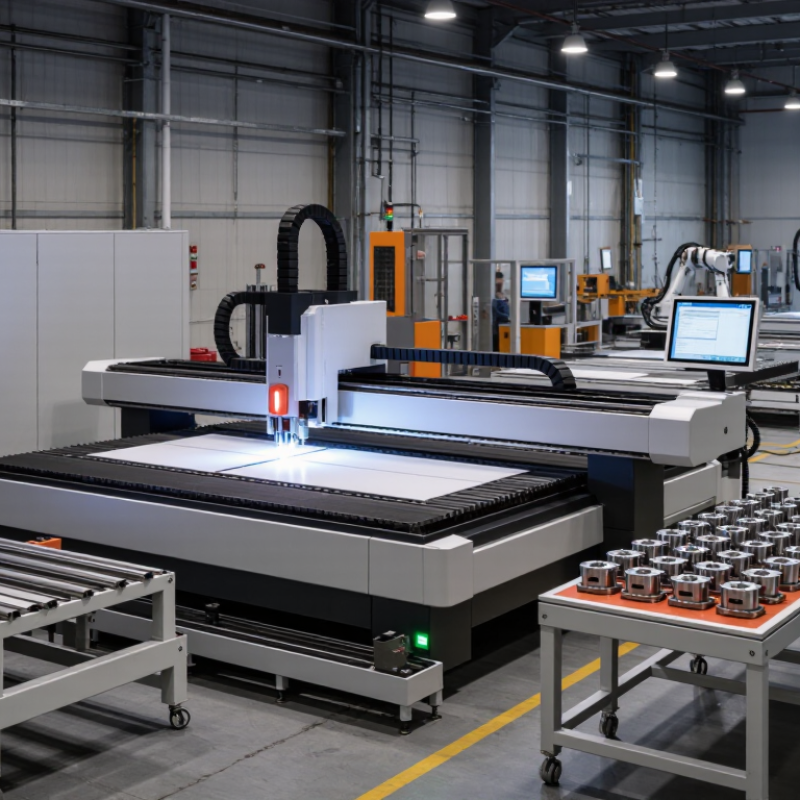
Automation in laser cutting means using connected software, sensors, and machines to control production with less manual intervention. It links design files, material handling, cutting settings, and quality checks. Instead of entering every parameter separately, an operator can prepare a controlled workflow.
A typical automated process starts with a CAD drawing and a nesting program. The software arranges parts to reduce sheet waste. The cutting system then adjusts speed, power, focus, and assist gas for the selected material. Sensors monitor the cutting head, plate position, and piercing process. If a sheet shifts slightly, the controller can pause or correct the path. Automatic loading and unloading also reduce lifting time and handling errors. Small details matter.
In practical workshop conditions, automation improves repeatability, especially during long production runs. It can keep hundreds of similar holes consistent and record useful process data. However, automation is not flawless. A dirty lens, incorrect material profile, or missed calibration can still damage a batch. I have seen efficient systems produce poor results after basic maintenance was ignored. Operators must inspect edges, measure finished parts, and question unusual data. Human judgment remains necessary. More sensors do not always mean better decisions. A simple manual check can reveal a problem the software overlooks.
| Automation Area | What the System Automates | Key Data Dimension | How It Is Measured | Efficiency Contribution |
|---|---|---|---|---|
| Material Loading and Unloading | Transfers sheets or cut parts between storage, the cutting table, and the unloading area. | Manual handling events | Number of operator handling steps per sheet; loading and unloading cycle time. | Reduces non-cutting labor and allows the cutting machine to spend more time processing material. |
| Automatic Sheet Positioning | Aligns the sheet against programmed reference points before cutting. | Positioning repeatability | Difference between the programmed datum and the detected sheet position. | Improves dimensional consistency and reduces setup errors caused by manual alignment. |
| Autofocus and Nozzle Control | Adjusts the focal position and maintains the programmed nozzle-to-sheet relationship for the selected material and thickness. | Focus position and standoff distance | Actual focus and height values compared with the cutting program. | Supports stable kerf formation, piercing, and edge quality across different material conditions. |
| Automatic Piercing Control | Uses programmed piercing parameters and process feedback to determine when a pierce has completed. | Piercing time and pierce success rate | Time from laser activation to confirmed breakthrough; number of failed or repeated pierces. | Limits unnecessary dwell time, reduces repeated piercing, and helps prevent scrap caused by incomplete piercing. |
| Nesting Optimization | Arranges multiple part geometries on a sheet while considering part spacing, grain direction, and remnant areas. | Material utilization |
Parts area divided by usable sheet area.
Utilization (%) = Parts Area ÷ Usable Sheet Area × 100 |
Reduces sheet waste and the number of sheets required for the same production order. |
| Cut-Path Optimization | Orders the cutting sequence and minimizes unnecessary rapid movements between contours. | Non-cutting travel distance | Total rapid-traverse distance and rapid-traverse time recorded by the CNC control. | Shortens cycle time without changing the programmed part geometry. |
| Assist-Gas Monitoring | Monitors or regulates assist-gas pressure and flow during cutting. | Gas pressure and flow stability | Actual pressure and flow compared with the programmed process window. | Helps maintain consistent dross removal, edge quality, and cutting conditions. |
| Cutting-Process Monitoring | Detects abnormal process signals such as unstable cutting, incomplete piercing, or collision risk. | Alarms, stoppages, and rework events | Alarm count, unplanned stop duration, rejected parts, and rework quantity. | Enables earlier intervention and reduces the chance that defects continue through an entire batch. |
| Digital Job Setup | Loads material data, thickness, cutting parameters, part programs, and job instructions electronically. | Setup time and data-entry errors | Time from job release to cutting start; number of incorrect parameter entries. | Improves repeatability between batches and reduces manual programming and setup work. |
| Production Data Collection | Records machine states, completed parts, cycle times, alarms, and material usage. | Availability, performance, and quality |
Overall Equipment Effectiveness can be evaluated as:
OEE = Availability × Performance × Quality |
Provides measurable information for identifying bottlenecks, downtime causes, and recurring quality problems. |
It reduces searching, lifting, measuring, and manual alignment. Sheets arrive in the correct sequence, thickness, and orientation.
It checks sheet dimensions, surface condition, orientation, warped edges, misplaced blanks, and leftover material.
Correct positioning prevents cutting errors. Vision systems, clamps, and probes help confirm the sheet’s actual location.
Yes. The system may adjust the cutting path when heat or slight sheet distortion changes the material position.
Programmed systems reduce manual pauses. They select paths, position sheets, and use steady movement between cutting profiles.
Sensors monitor height and material position. Stable focus, gas control, and calibration support consistent edges and dimensions.
Yes. Good nesting places shapes close together and increases usable parts from each sheet. Overly dense layouts may create heat problems.
Dirty sensors, contaminated optics, warped sheets, reflective surfaces, and incorrect thickness settings can cause repeated mistakes.
Operators should inspect early parts, measure critical holes, and review edge quality. A short pause may prevent hours of rework.
Track cycle time, loading errors, scrap rate, manual corrections, and unplanned stops. Fast cycles can hide deeper problems.
No. Experienced workers adjust settings, inspect parts, review alarms, and respond before minor faults become long stoppages.
Feedback reveals why parts fail. Teams can refine loading rules, nesting plans, and cutting settings based on actual results.
Not necessarily. Fewer surprises, stable quality, and reduced rework may create greater value than raw speed.
Automation in laser cutting combines programmable controls, material-handling equipment, sensors, and production software to coordinate the entire cutting process. It can automatically load sheets, identify their dimensions, align them accurately, and position them for efficient use of the work area. This preparation reduces manual handling and helps maintain consistent results between jobs.
So, how does automation improve laser cutting efficiency? It increases cutting speed and accuracy by optimizing tool paths, adjusting operating parameters, and coordinating movement with fewer interruptions. Sensors can detect material position, surface changes, and process conditions, allowing the system to correct small errors before they affect the final parts. Software can also monitor production data, reduce unnecessary motion, improve material nesting, and identify potential problems early. The overall efficiency depends on factors such as material type and thickness, machine capacity, programming quality, sensor reliability, maintenance, operator training, and how well the automated system fits the production workflow.

 Stylo Laser