A laser can cut a clean edge in one alloy and leave another rough, discolored, or warped. The beam may be unchanged; the material is not. That difference explains why is material selection important in laser processing: a material’s composition, thickness, surface condition, and response to heat all influence the result. Choosing poorly can mean excess melting, inconsistent cuts, or extra finishing work. Choosing well helps produce a process that is more predictable and suited to the part’s purpose.
Theodore Maiman, whose work helped establish the laser era, famously said, “The laser is a solution looking for a problem.” His remark was not specifically about material selection, but it offers a useful caution: the technology alone does not guarantee a good outcome. In practice, engineers test samples, inspect edges, and adjust power, speed, and focus for the material at hand. A polished sheet may behave differently from a coated or oxidized one. Small details matter.
And testing can surprise you. Material data sheets help, but they cannot replace a trial on the actual grade and surface finish. A process that looks efficient on paper may produce an edge that needs costly cleanup. The best choice balances cut quality, production speed, safety, and downstream requirements. It is not always obvious. That is why material selection deserves attention before production settings are treated as final.
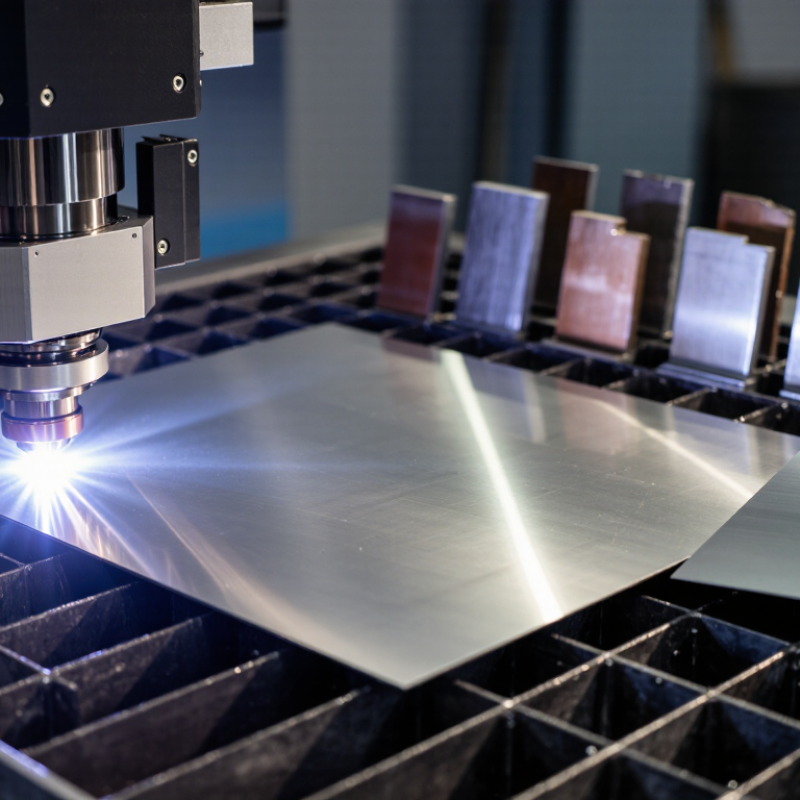
How Wavelength Affects Absorption: Copper Reflects ~95% at 1.06 μm
At 1.06 μm, polished copper may reflect about 95% of incoming laser light. That leaves only a small fraction absorbed at the surface. The figure is an approximation: copper’s optical response changes with surface finish, oxidation, incidence angle, and temperature. Johnson and Christy’s measured optical constants for metals, later compiled in Palik’s Handbook of Optical Constants of Solids, provide a technical basis for estimating this behavior. Real production parts are rarely perfect optical samples.
This low initial absorption can make laser coupling less predictable. A beam may glance off a clean copper surface, while scratches or oxide patches absorb differently. Once heating begins, surface conditions change, and absorption can rise. That transition matters. It can affect start-up stability, energy input, and the consistency of a weld or cut. The 95% figure should not be treated as a fixed setting for every copper part; that assumption is easy to make, and easy to regret.
Tips: Check the actual alloy and surface condition before setting process parameters. Test coupons from the same material lot, then inspect the result under consistent conditions. If coupling remains unstable, evaluate a wavelength with stronger copper absorption and verify it through controlled trials.
How Heat Spreads: Aluminum Conducts ~237 vs 304 Stainless ~16 W/m·K
Thermal conductivity determines how quickly heat moves away from a laser spot. Reference values in ASM International’s ASM Handbook place pure aluminum near 237 W/m·K, while 304 stainless steel is about 16 W/m·K at room temperature. These are useful benchmarks, not fixed settings: alloy, temper, temperature, and surface condition can shift real results. The gap is still striking. Heat travels through aluminum roughly fifteen times faster.
At the machine, that difference can change the cut edge. Aluminum pulls heat from the beam zone quickly, which can demand more laser energy to maintain a stable melt and may leave a wider heat-affected area if settings are poorly matched. Stainless steel holds heat closer to the cut, often supporting a narrower thermal zone, but excessive dwell can overheat thin edges. Small details matter. A reflective aluminum surface, a 1 mm sheet, and a slow feed rate do not behave like a clean, thicker plate. Industry material-property references, including ASM data tables, help set expectations; test coupons should confirm them. One limitation is easy to overlook: conductivity alone cannot predict cut quality. Assist gas, focus position, power density, and alloy composition matter too. And shop-floor results can be messier than the tables.
Why Is Material Selection Important in Laser Processing? — How Heat Spreads
| Material |
Thermal Conductivity at About 20°C (W/m·K) |
Approximate Density (g/cm³) |
Typical Laser-Processing Consideration |
| Aluminum, high-purity |
About 237 |
About 2.70 |
Conducts heat rapidly, spreading energy away from the interaction zone. Localized heating may require careful control of power, speed, and focus. |
| 304 stainless steel |
About 16.2 |
About 8.0 |
Conducts heat much less readily than aluminum, so heat tends to remain more localized. Thermal gradients and distortion still depend on part geometry and process settings. |
| Copper, high-purity |
About 401 |
About 8.96 |
Very high thermal conductivity can make it challenging to maintain a concentrated heat zone. Absorption also depends strongly on laser wavelength and surface condition. |
| Carbon steel, representative values |
About 45–60 |
About 7.85 |
Conductivity varies with grade and temperature. Its heat-spreading behavior is generally between that of high-purity aluminum and 304 stainless steel. |
| Commercially pure titanium, Grade 2 |
About 16–22 |
About 4.51 |
Relatively low thermal conductivity can concentrate heat near the processed area. Shielding and atmosphere control may be important because hot titanium reacts readily with oxygen. |
Values are approximate, representative room-temperature figures; actual properties vary by alloy, composition, and temperature. Thermal conductivity affects how quickly heat spreads, but laser-processing results also depend on wavelength, surface condition, power, travel speed, focus, and part geometry.
How Melting Points Set Process Windows: Aluminum 660°C, Copper 1,085°C
In laser processing, melting point is a useful boundary, not a complete recipe. Aluminum melts at about 660°C, while copper melts at about 1,085°C. That 425-degree gap changes how much heat the material must absorb before a melt pool can form. But the laser does not heat a neat textbook sample. It meets a moving surface, often with oxide, roughness, or a thin coating.
Copper also carries heat away quickly and reflects much incoming laser energy, especially at some wavelengths. A small, fast-moving beam may therefore struggle to start a stable pool, even when the target temperature seems straightforward. Aluminum melts sooner, yet its oxide skin can remain solid above the metal’s melting point. Awkward, but important.
In practice, engineers tune power, spot size, travel speed, and shielding gas together, then inspect bead shape and spatter. A shiny edge or darker heat-affected zone can signal uneven energy input. Alloy composition and sheet thickness shift the response again, so published settings need validation on the actual part. A coupon test is modest work; skipping it can make a narrow process window look deceptively broad.
How Thickness and Surface Finish Influence Cutting, Welding, and Marking
Thickness and surface finish can change how a laser behaves, even when two parts use the same material. A thin sheet may cut quickly, while a thicker section needs slower travel and carefully controlled power. Too much heat can leave a wide kerf, rough edges, or discoloration. Small details matter. A polished surface may reflect more energy than a matte one, so settings that work on a brushed sample may not transfer reliably.
Tips: Test on a scrap piece with the same thickness and finish. Check the cut edge, weld penetration, or mark contrast before processing the full part. Keep the sample clean; fingerprints and oil can affect results.
For welding, thickness influences heat input and the risk of burn-through or weak fusion. Surface coatings, scale, and unevenness can also disrupt the joint. Marking depends on how the surface absorbs energy: a coated panel may produce a clear contrast, while a reflective finish can create a faint or inconsistent mark. In practice, surface descriptions are not always precise, so verify the actual part rather than relying only on a material specification. That can mean an extra test, but it is often less costly than reworking a batch.
Why Material Selection Matters in Laser Processing
Thermal conductivity affects how quickly heat spreads through a material during cutting, welding, and marking. Higher conductivity can carry heat away from the process zone, so material, thickness, laser settings, and surface condition should be considered together.
How to interpret: Values are approximate room-temperature figures; alloy and temper can change them. Greater thickness generally requires more energy or slower processing, while surface oxides, coatings, and roughness can change laser absorption and process consistency. Validate settings on the actual material and finish.
How Material Properties Guide Laser Type, Parameters, and Quality Control
Material selection shapes every laser-processing decision. Wavelength matters because materials absorb light differently. So do thermal conductivity, reflectivity, thickness, and surface finish. Copper illustrates the challenge: Copper Development Association data for C10100 report thermal conductivity near 391 W/m·K, while ASM Handbook data put 304 stainless steel near 16 W/m·K at room temperature. Copper spreads heat quickly and reflects much near-infrared light, so a setup that cuts steel cleanly may leave copper with poor edge quality. Wavelength, pulse duration, and beam delivery must match the material, not just the machine’s rated power.
These properties guide parameter tuning. Higher conductivity can demand greater energy density or faster delivery; excessive heat can widen the heat-affected zone. A reflective surface may need a wavelength it absorbs more readily. Test coupons reveal whether power, speed, focus, and assist gas produce a narrow kerf without dross or discoloration. Measure cut width and inspect edges under consistent lighting. One caveat: handbook values are useful starting points, not shop-floor guarantees; alloy, temper, coating, and surface condition can change results. I would not skip a small trial, even when the material looks familiar.
Tips: Record material grade, thickness, wavelength, power, speed, and focus position with each test. Change one setting at a time. Check both the top edge and underside; clean-looking cuts can still hide taper or heat damage.
Conclusion
Understanding why is material selection important in laser processing begins with how a material interacts with the laser beam. Copper reflects about 95% of light at a wavelength of 1.06 μm, so achieving effective energy absorption can be challenging. Heat conduction also matters: aluminum transfers heat at roughly 237 W/m·K, while 304 stainless steel conducts at about 16 W/m·K. This difference affects how quickly heat spreads and how precisely a cut, weld, or mark can be controlled.
Melting points help define suitable process windows: aluminum melts at around 660°C, compared with copper at 1,085°C. Thickness and surface finish further influence energy requirements, cutting speed, weld penetration, and marking clarity. By considering these properties together, operators can choose an appropriate laser type and adjust power, speed, focus, and other parameters. Careful selection and quality checks help produce consistent results while reducing defects and unnecessary heat damage.

 Stylo Laser